

Forgotten Graphs #2: Inverse Trig functions

In the second part of the series of Forgotten Graphs I will be looking at inverse trig functions.
Why do students forget this group of functions/graphs?:
It does not come up that often in past papers.
The process to sketch them can be forgotten.
Students often do not see the link with sin-1(x) and arcsin(x) (and the rest) and hence leave it blank.
As you can see below here are the 3 graphs that students need to be able to recall.

In reality how does a student remember these?
These graphs show inverse functions- which means that the original functions had a 1-1 mapping. We know of sin(x), cos(x) and tan(x) that they are not 1-1 mappings UNLESS you restrict the domain.
Lets see the stages to construct the inverse sine function:
Start with the sin(x) with the domain restricted between -pi/2 and pi/2. This ensures we have a 1-1 mapping.

To create the inverse function from this you will have to reflect this graph in the line y=x . This is the general method to sketch an inverse function.

Once you reflect it in the line y=x you have got your inverse function. However you need to remember that the domain of the inverse comes from the range of the original and the range of the inverse comes from the domain of the original:
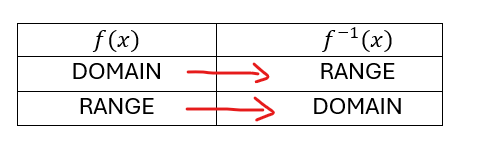
Therefore it is important to note that the domain of the original sin(x) graph was between -pi/2 and pi/2 inclusive. The range was between -1 and 1 inclusive.
The domain of the inverse will now be between -1 and 1 inclusive and the range of the inverse will be between pi/2 and -pi/2 inclusive as evidenced below:

The same premise applies to the cos(x) graph and the tan(x) graph and it worth looking in your textbooks on how their inverse graphs are generated.
Conclusion
Do not underestimate inverse trig graphs- they can come up and can be difficult unless you have prepared adequately. They can link with transformations, sketching, and solving.
Here are some questions to help you practice:

Comments